
You have people.
You have tools.
You still don't know what's happening with your GTM.
Marketing says pipeline is strong, Sales says it's not, and Finance has no idea what data they are looking at.
The problem isn't tools or the people. It's orchestration. RevOps Copilot diagnoses what's actually broken and tells you whether you need to revamp your tools, your people, or build better orchestration. Most teams discover they need the latter.
Built by Luciana Vecchi, GTM Effectiveness & Operating System Advisor. 20+ years scaling global GTM strategy at Adobe, NetApp, and AWS. Book a working session →
Faster growth at companies with true GTM alignment.
Annual cost of GTM misalignment, not from missing dashboards, from missing connective tissue.
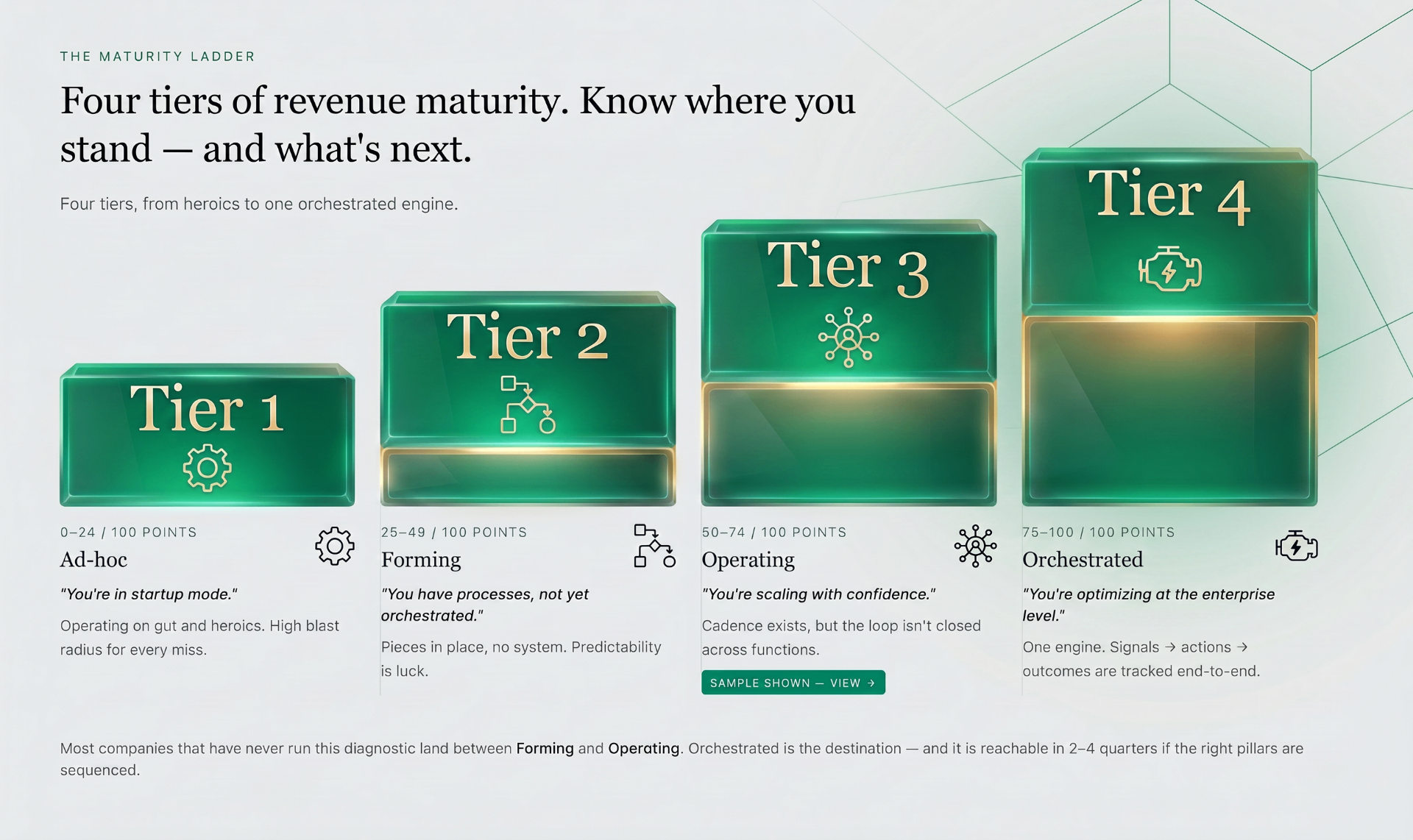
Most companies that have never run this diagnostic land between Forming and Operating. Orchestrated is the destination, reachable in 2–4 quarters if the right pillars are sequenced.
See sample result (Tier 3 · Operating) →Most revenue challenges aren't product challenges. They're systems challenges, and your revenue operating system is evolving.
When a new CRO or CEO steps in without a RevOps foundation, the org operates on gut instinct, disconnected data, and siloed teams. Revenue stalls when the connective tissue between functions is missing.
"It is often confused with forecasting or revenue operations, but numbers alone don't move organizations. You can align on targets and still fail if teams aren't focused on the right programs, if messaging is fragmented, or if people across functions aren't genuinely bought in."
RevOps Copilot encodes the playbook a senior operator would build for you: pillars, cadences, KPIs, tools, and the leadership moves that get a CMO, CRO, and Head of Product genuinely rowing together.
A maturity diagnostic + action planner. Not a dashboard. Not a process document.
In 25 questions you get a maturity score per pillar, your revenue operating system tier (Tier 1–4), a prioritized 90-day plan with a week-by-week checklist, and a comparison to companies like yours. Use it standalone, or as the starting point for a working session.
- ✓6-minute diagnostic (25 questions)
- ✓Maturity score per pillar
- ✓Your revenue tier (Tier 1–4)
- ✓Prioritized 90-day action plan
- ✓Week-by-week execution checklist
- ✓No credit card. No opt-in. Just results.
When to run this diagnostic.
You're a new CRO or GTM leader (first 90 days)
Use it to prioritize what to fix first.
Your revenue feels unpredictable
Use it to diagnose why Sales and Marketing forecasts don't align.
You're post-acquisition
Use it to align the combined sales org around one system.
Your enablement spend isn't moving win rates
Use it to clarify if the problem is training or alignment.
You're scaling beyond your first 50 reps
Use it to identify which pillar will break first (usually Revenue Architecture).
Sales enablement orgs
Diagnose whether the gap is training (Pillar 4) or alignment (Pillar 3) before throwing more budget at it.
Five pillars of a modern revenue engine.
- 01
Revenue Architecture
The single source of truth
The data backbone of your revenue organization, and one named owner who decides it. Without a trusted source of truth and clear ownership, every forecast, report, and decision is built on sand.Weeks 1–3 - 02
Forecast & Pipeline Engine
Predictable revenue, weeks before close
The mechanism that tells the CRO and CEO what revenue is coming, with what confidence, and where the risks are, weeks before the quarter closes.Weeks 2–6 - 03
GTM Alignment & Process
One mission. One engine.
A unified operating model where Sales, Marketing, and Customer Success share the same goals, definitions, handoff points, and accountability framework.Weeks 3–8 - 04
Revenue Enablement
ONE customer experience, ONE voice
The evolution of sales / field enablement into an end-to-end Revenue Enablement discipline, Sales, Leadership, Technical, Partner, and Customer Academies organized around Onboarding → Always-Boarding → Just-in-Time → Effectiveness. Breaks the silo between marketing, sales, partners, customers, and support so the buyer hears ONE voice across the entire journey.Weeks 4–10 - 05
GTM Effectiveness Loop
The closed loop: signal → action → outcome
The most transformational capability. A GTM Effectiveness AI Agent orchestrates people, data, KPIs, and actions across the entire revenue organization. Not a dashboard: a living system that detects signals, surfaces insights, recommends actions, and tracks whether those actions drove outcomes.Weeks 8–16
The goal isn't more tools. It's a closed loop where every action ties to an outcome.
That loop, powered by AI, is what separates a modern revenue organization from one operating on hope.
See the full method →Find out where revenue stalls. Get the plan to fix it.
25 questions. 6 minutes. A maturity score per pillar and a personalized 0–90 day action plan you can take to your next board meeting.
Run the diagnostic (6 min) →Pipeline coverage +42–73%, forecast visibility 80%, revenue +20% YoY, from operating discipline, not new hires.
At a rapidly growing enterprise SaaS company, the GTM function lacked operational discipline: Sales was reactive, forecasting was unreliable, and enablement was inconsistent across regions. I built a PMO-driven GTM operating model from scratch: unified planning cadence, portfolio-based deal prioritization, and coordinated ramp training.
Within 2.5 years, pipeline coverage grew 42–73%, forecast visibility reached 80%, revenue increased 20% YoY, productive sellers increased 49%, and ramp time compressed 45%, growth from operating discipline, not just hiring.